W—achilcaraspua—598
ex luce
Location — Galerias de Punta Begoña, Getxo
Country — Spain
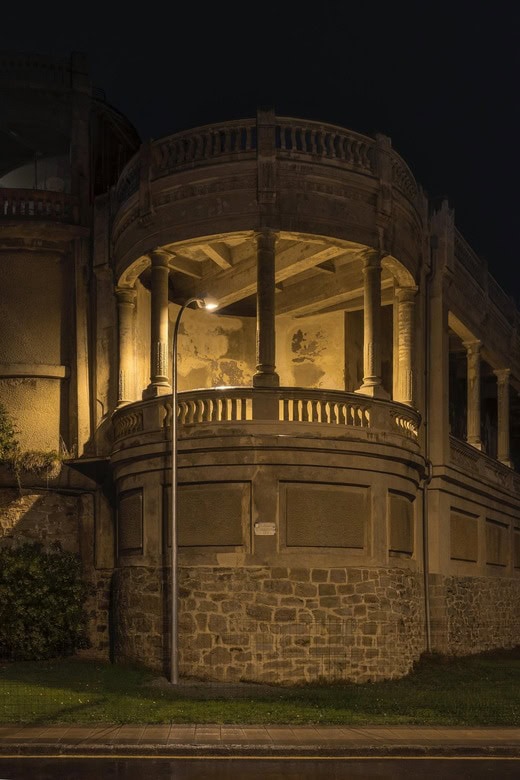



Temporary installation carried out during October and November 2025 as part of the OPEN House Bilbao festival in the galleries of Punta Begoña in Getxo (Bizkaia). This complex—a combination of retaining walls, salons, and Art Nouveau-style viewpoints designed by architect Ricardo Bastida in the 1910s—sits along the perimeter of the estate once owned by the magnate Horacio Echevarrieta in the neighborhood of Neguri.
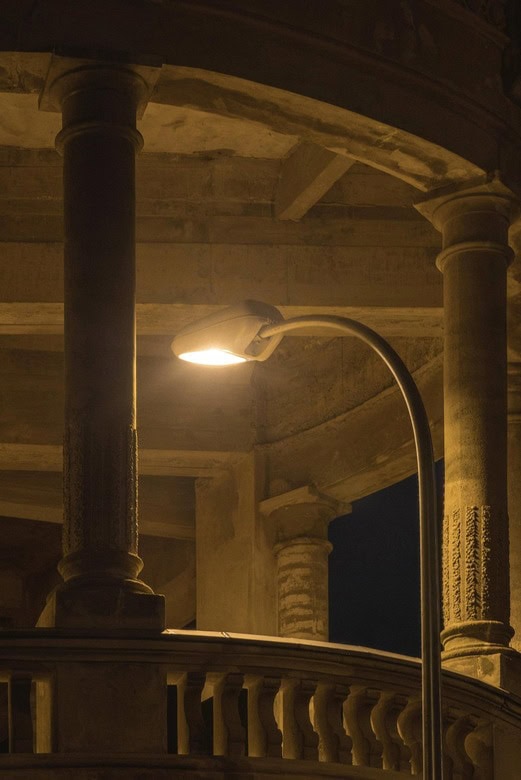
A public streetlamp turns inward; as its light falls, silence and darkness emerge. Yellow and intense, it spills over the void, capturing what remains hidden. It does not illuminate matter; it traces the mystery of its own interior emptiness. Architecture is contemplated in its absence. The gesture is temporary, perhaps futile against the scale of what was built, returning to its slumber and the persistent penumbra that surrounds it once it ceases. The intangible is poetized: a state suspended between wakefulness and sleep, between word and image, sustained by the evocative power of shadow.
It is said that when Echevarrieta arrived in Getxo by boat, he would order the Punta Begoña galleries to be illuminated to announce his return from business trips. This gesture, charged with theatricality and symbolism, transformed the cliff where the complex sits into a stage where power became visible and architecture functioned as a device for personal projection. The construction—originally conceived as a retaining wall—now stands as a physical testimony to the unusual ambition and bold vision of the Bilbao magnate. What began as civil engineering was transformed, under his direction, into a singular space: salons, colonnades, and viewpoints, oscillating between domestic and representative, private and public, human and landscape. As a nod to this attributed habit, the installation—a composition of objects evoking an inverted lighthouse—activates a corner of the gallery historically known as “the lantern.” Its purpose is to invite reflection on the symbolic, social, and cultural dimension of Punta Begoña through the evocative power of light.
The streetlamp, an unexpected witness, peers into the viewpoint: a space conceived for both observation and being observed. There, it delivers its light with apparent innocence, illuminating conversations and transforming its otherwise banal condition into a gesture of displaced meaning. The lantern—the circular pavilion crowning the belvedere over the landscape—becomes the stage for a convergence of forces: looking inward and projecting outward, the intimate and the public. At this intersection, the object emerges as a dissonant element that, unintentionally, reactivates latent memories finding a crack through which to resurface. Light functions as a mediator between the symbolic, the real, and the imaginary, facilitating encounters between bodies and words, exposing the fragility of perception. The viewpoint becomes a relational device, a convergence point between what is visible and the awareness of being seen.
In this unexpected assemblage with the existing architecture, the installation acquires a trans-scalar dimension. This principle allows architectural interventions to be reinterpreted through a logic of multiplicity, reconfiguring physical limits, normative frameworks, and established conventions to suggest more spontaneous, organic, and critical modes of operation in an increasingly tensioned context.